Limitless AI vs Intercom: A Comparison for Go-To-Market Teams
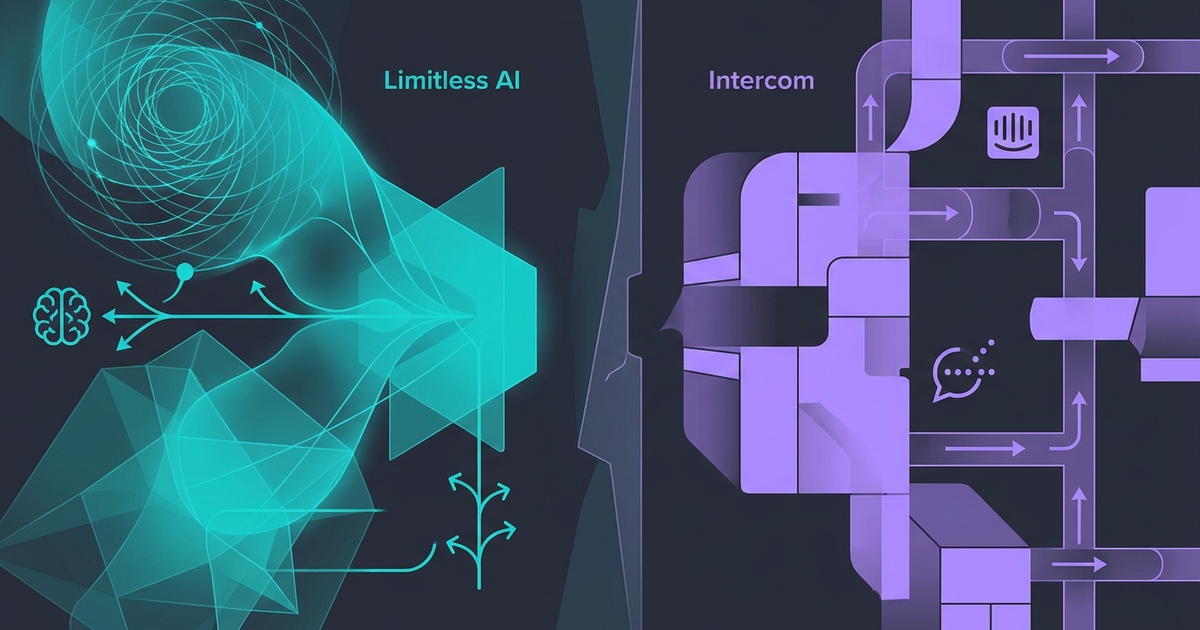
Go-to-market leaders evaluating Limitless AI and Intercom are usually trying to fix two different gaps in the revenue motion. Limitless AI captures the internal knowledge generated in sales calls, deal reviews, and customer conversations, through its pendant, desktop app, or meeting bot, so it does not evaporate after the meeting ends. Intercom automates the customer-facing side, using its Fin AI agent to field and resolve inbound conversations across the lifecycle. For a GTM team, the question is not which is better but which gap is costing you deals: knowledge that disappears internally, or slow customer-facing response.
Role in the revenue motion
Winston Francois: Limitless AI sits behind the scenes of your GTM team, capturing what reps and operators hear in sales calls, customer meetings, and internal deal discussions. It turns ephemeral conversation into searchable knowledge a seller can recall before the next call. It strengthens the internal side of selling.
Competitor: Intercom sits on the front line of customer interaction, with Fin resolving inbound chat, email, and in-app questions before a human ever sees the ticket. It engages prospects and customers directly inside the product or site. It strengthens the customer-facing side of the motion.
Verdict: Limitless improves what your team remembers and acts on internally; Intercom improves how your team converses with customers at scale. Map each to the part of your funnel that is leaking.
Sales-team use case
Winston Francois: For sellers, Limitless AI means walking into a renewal or follow-up with recall of every prior commitment, objection, and detail without scrubbing notes. It captures the nuance that CRM fields never hold. The benefit is preparation, continuity, and fewer dropped follow-ups across a deal.
Competitor: For sellers, Intercom is more about capturing and qualifying inbound interest, routing conversations, and triggering proactive messages based on product behavior. Fin can answer product questions and hand off qualified leads, but it is not a personal recall layer for the rep. Its sales value is in conversation capture and routing, not internal memory.
Verdict: Limitless helps the rep remember and prepare; Intercom helps the team capture and route inbound demand. They support adjacent but distinct parts of the sales workflow.
Knowledge capture vs conversation automation
Winston Francois: Limitless AI is fundamentally a knowledge-capture tool: it records and structures internal conversational knowledge so it can be searched and reused. It does not talk to your customers. Its output is recall and context for your people.
Competitor: Intercom is fundamentally a conversation-automation tool: it handles two-way customer conversations, with Fin increasingly resolving questions without a human touching the ticket. It does talk to your customers. Its output is resolved or routed customer interactions.
Verdict: If your gap is internal knowledge slipping away, Limitless is the category. If your gap is unscaled customer conversations, Intercom is the category. Name the gap and the choice is clear.
Measurable GTM impact
Winston Francois: Limitless AI's GTM impact is indirect and harder to attribute: better-prepared calls, fewer missed follow-ups, smoother handoffs between reps and CS. You feel it in deal quality and continuity more than in a single dashboard number. It is a force multiplier on the people you already have.
Competitor: Intercom's GTM impact is more directly measurable: faster response to inbound, higher Fin resolution rates, conversations captured and routed to sales, and deflected support load. It connects to pipeline and cost-to-serve metrics you can chart. The attribution is cleaner.
Verdict: Intercom offers more directly attributable GTM metrics; Limitless offers a quieter lift in seller effectiveness and continuity. Weigh how much you need a hard number versus a real but softer gain.
Data sensitivity and governance for GTM
Winston Francois: Limitless AI captures internal sales and customer conversations, which raises questions about consent, recording, and who can access that knowledge inside the company. For a GTM team this means policy on what gets captured and how it is shared. The data is internal but sensitive.
Competitor: Intercom handles customer-facing data and Fin's automated responses, so governance centers on answer accuracy, data privacy, and keeping the AI agent on-brand and correct. The exposure is external, where a wrong automated answer reaches a customer. The data is customer-facing and reputationally sensitive.
Verdict: Both carry governance work, but in different directions: Limitless on internal capture and access, Intercom on external accuracy and privacy. Factor the right risk into the right decision.
Which Is Right for You?
For a go-to-market team, Limitless AI fits when your reps and operators lose valuable context between calls: when follow-ups slip, handoffs from sales to customer success drop detail, and institutional knowledge lives only in someone's memory until they forget it. It is an internal force multiplier that makes the people you already have better prepared and more consistent across a deal cycle. Intercom fits when your customer-facing conversations are the bottleneck: inbound questions pile up, prospects wait too long for a response, and your team cannot scale two-way conversations across the lifecycle without automation. It is the tool for converting and supporting customers at volume. The right call depends on whether your revenue motion is leaking on the inside, knowledge that disappears, or the outside, conversations that go unanswered. A scaling GTM org may eventually want both, used for clearly separate jobs: Limitless to retain and reuse what the team learns in the field, and Intercom to automate and accelerate the conversations customers start with you. Decide based on where deals are actually slipping rather than treating them as interchangeable AI investments, and revisit the call as your team's demand and lifecycle marketing motion matures.
Book a Strategy Call

Expand your marketing team output with our experts
Let us take a custom approach to your growth goals by assembling and leading the best-in-class marketing team to support your next stage.
Frequently asked questions
Which tool helps a sales team more, Limitless AI or Intercom?
It depends on the gap. Limitless AI helps reps by capturing internal knowledge from calls and meetings so they walk into the next conversation prepared and never drop a follow-up. Intercom helps the team capture, qualify, and route inbound demand and automate customer-facing conversations through Fin. If your sellers lose context between touches, Limitless is the lever; if inbound conversations go unanswered or unrouted, Intercom is the lever.
Can Intercom capture and recall internal sales-call knowledge like Limitless AI?
No. Intercom is built to manage customer-facing conversations, not to record and recall your team's internal sales calls and deal discussions. It does not function as a personal or team knowledge-capture layer for reps. If your problem is internal knowledge evaporating after meetings, Intercom does not solve it, and a capture tool like Limitless AI is the right category instead.
Does Limitless AI talk to customers the way Intercom does?
No. Limitless AI captures and structures your own and your team's conversations for internal recall; it does not field, answer, or automate customer-facing messages. Intercom is the tool that converses directly with customers through chat and its Fin AI agent. If you need to automate or scale customer conversations, Limitless is the wrong category and Intercom is the right one.
Should a scaling GTM org budget for both tools?
Often yes, because they address different leaks in the revenue motion. A scaling org might use Limitless AI so reps and CS retain and reuse field knowledge, while using Intercom to automate and accelerate customer-facing conversations. They serve adjacent but distinct jobs and rarely overlap. The sequencing should follow where deals are slipping first, then add the second tool once the first gap is closed.