Product-Led Growth vs Sales-Led Growth
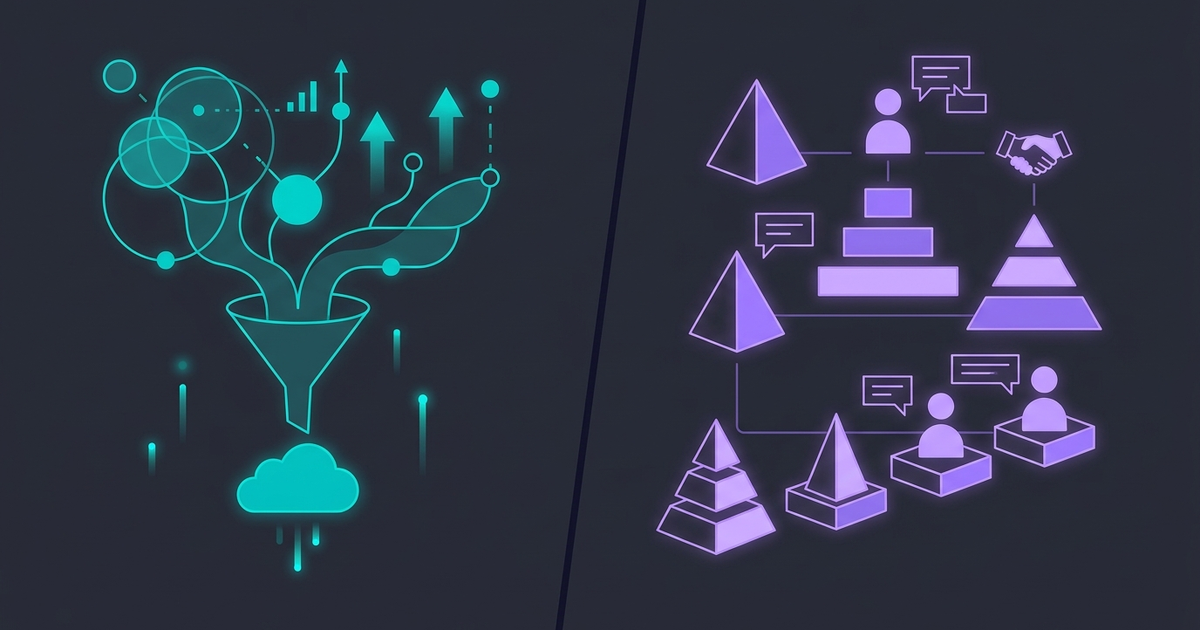
Founders often pick a go-to-market motion based on what is fashionable rather than what their product and price point can actually support. Product-led growth lets the product sell itself through free trials, freemium, and self-serve onboarding. Sales-led growth puts humans in the loop to qualify, demo, and close. Picking the wrong one wastes a year and a lot of payroll. This comparison breaks down what each motion requires to work, where each breaks down, and how to choose based on your time-to-value, deal size, and buyer behavior rather than the latest podcast you listened to.
How the Buyer Reaches Value
Winston Francois: PLG requires a product that delivers obvious value before a human gets involved. The user signs up, reaches an aha moment in minutes to days, and expands usage on their own. Onboarding, activation design, and in-product guidance are the growth team, not the sales team.
Competitor: Sales-led growth assumes the buyer needs help to see and trust the value. A rep qualifies the need, runs a tailored demo, handles objections, and navigates procurement. Time-to-value is mediated by a person, not the product surface.
Verdict: If a motivated user can reach real value alone, PLG is viable and cheaper to scale. If value requires configuration, integration, or executive buy-in before it is visible, sales-led is the realistic motion. The product's time-to-value is the deciding constraint.
Deal Size and Unit Economics
Winston Francois: PLG works best with low-to-mid price points where the cost of self-serve acquisition is small relative to a high volume of accounts. Economics depend on conversion from free to paid, expansion within accounts, and keeping CAC near zero on the front end.
Competitor: Sales-led growth works best with larger deal sizes that can absorb the cost of a rep, sales engineering, and a multi-month cycle. Economics depend on win rate, sales cycle length, and average contract value justifying the fully loaded cost of the team.
Verdict: A small deal size cannot fund a sales rep, so it must be sold self-serve. A large, complex deal rarely closes itself, so it needs a human. The break point is where average contract value crosses the cost of the people required to close it.
Who Holds the Budget
Winston Francois: PLG thrives when the end user can adopt without permission and start paying on a card or a small budget. Bottom-up adoption spreads inside an organization before any central buyer is involved, and usage data makes the eventual expansion conversation easy.
Competitor: Sales-led growth fits top-down purchases where a buying committee, security review, and procurement gate the decision. The person who uses the product is rarely the person who signs, so a rep has to orchestrate multiple stakeholders.
Verdict: If your user can swipe a card without asking anyone, PLG can ignite bottom-up. If the purchase needs sign-off from people who never touch the product, you need sales to navigate the committee. Buyer authority dictates the motion as much as price does.
Where Growth Investment Goes
Winston Francois: PLG concentrates investment in product, onboarding, activation analytics, lifecycle messaging, and self-serve infrastructure. The growth team is engineers, product managers, and data analysts instrumenting the funnel inside the product.
Competitor: Sales-led growth concentrates investment in headcount – reps, sales engineers, sales development – plus enablement, CRM, and pipeline operations. Scaling means hiring and ramping people, which is slower and more expensive but works for complex deals.
Verdict: PLG scales through code that runs at near-zero marginal cost; sales-led scales through people at high marginal cost. PLG has higher upfront product investment and lower marginal cost per account. Sales-led has lower upfront investment and higher marginal cost per deal.
Time to Repeatable Pipeline
Winston Francois: PLG can take longer to get the product and funnel right, but once activation and conversion work, the motion scales fast and cheaply. The risk is front-loaded into building a product that genuinely sells itself.
Competitor: Sales-led growth can stand up pipeline faster by hiring reps and pointing them at a target list, but each increment of growth requires another hire. The risk is back-loaded into rising cost as you scale the team.
Verdict: PLG is slower to ignite and faster to scale once it works. Sales-led is faster to ignite and more linear to scale. Companies that need pipeline immediately often start sales-led, then layer PLG underneath as the product matures.
Which Is Right for You?
Choose product-led growth if your product reaches obvious value fast without human help, your price point is low enough that self-serve acquisition is affordable, and your end users can adopt and pay without a procurement gate. PLG rewards companies willing to invest heavily in onboarding, activation analytics, and in-product experience before the motion scales. Choose sales-led growth if your deal size is large enough to fund a rep, your value requires configuration or executive buy-in to be visible, and your purchase runs through a buying committee. Most companies between $5M and $100M ARR end up running a hybrid: PLG to capture self-serve and bottom-up adoption at the low end, and a sales-led motion to convert those signals into larger enterprise contracts. The common mistake is forcing one motion onto a product whose time-to-value, price point, and buyer authority point clearly to the other – or refusing to add the second motion once the first hits its natural ceiling.
Book a Strategy Call

Expand your marketing team output with our experts
Let us take a custom approach to your growth goals by assembling and leading the best-in-class marketing team to support your next stage.
Frequently asked questions
Can a company run both product-led and sales-led growth at the same time?
Yes, and many growth-stage companies should. A common hybrid uses PLG to capture self-serve and bottom-up adoption while a sales team works the larger accounts and converts high-usage free users into enterprise contracts. The two motions share product usage data, which makes the sales conversation far easier because the rep already knows who is engaged. The key is clear ownership boundaries so the self-serve funnel and the sales pipeline do not fight over the same accounts.
How do I know if my product is a fit for product-led growth?
Ask whether a motivated user can reach a real aha moment on their own, in minutes to days, without a rep or heavy configuration. If yes, and your price point is low enough that self-serve acquisition is affordable, PLG is viable. If value only appears after integration, custom setup, or executive alignment, the product is not yet self-serve and a sales-led motion is more realistic. Time-to-value without human help is the single biggest predictor of PLG fit.
Is product-led growth cheaper than sales-led growth?
PLG has a lower marginal cost per account because the product does the selling at near-zero incremental cost, but it carries a higher upfront investment in product, onboarding, and activation infrastructure. Sales-led has a lower upfront cost to stand up but a higher marginal cost per deal because growth requires hiring more people. Which is cheaper overall depends on your deal size and volume. Small, high-volume deals favor PLG economics; large, complex, low-volume deals favor sales-led.
When should a PLG company add a sales team?
Add sales when your usage data shows accounts growing large enough to justify a human, when enterprise prospects request features like security review or custom contracts, or when self-serve conversion plateaus on accounts that clearly have more budget. The cleanest trigger is a cohort of high-usage free or low-tier accounts that a rep could expand into significantly larger contracts. Layering sales onto a working PLG motion lets you capture upmarket revenue without abandoning the efficient self-serve base.